Electrical Insulation Tester UK: Choosing Your First 250V/500V/1000V Meter
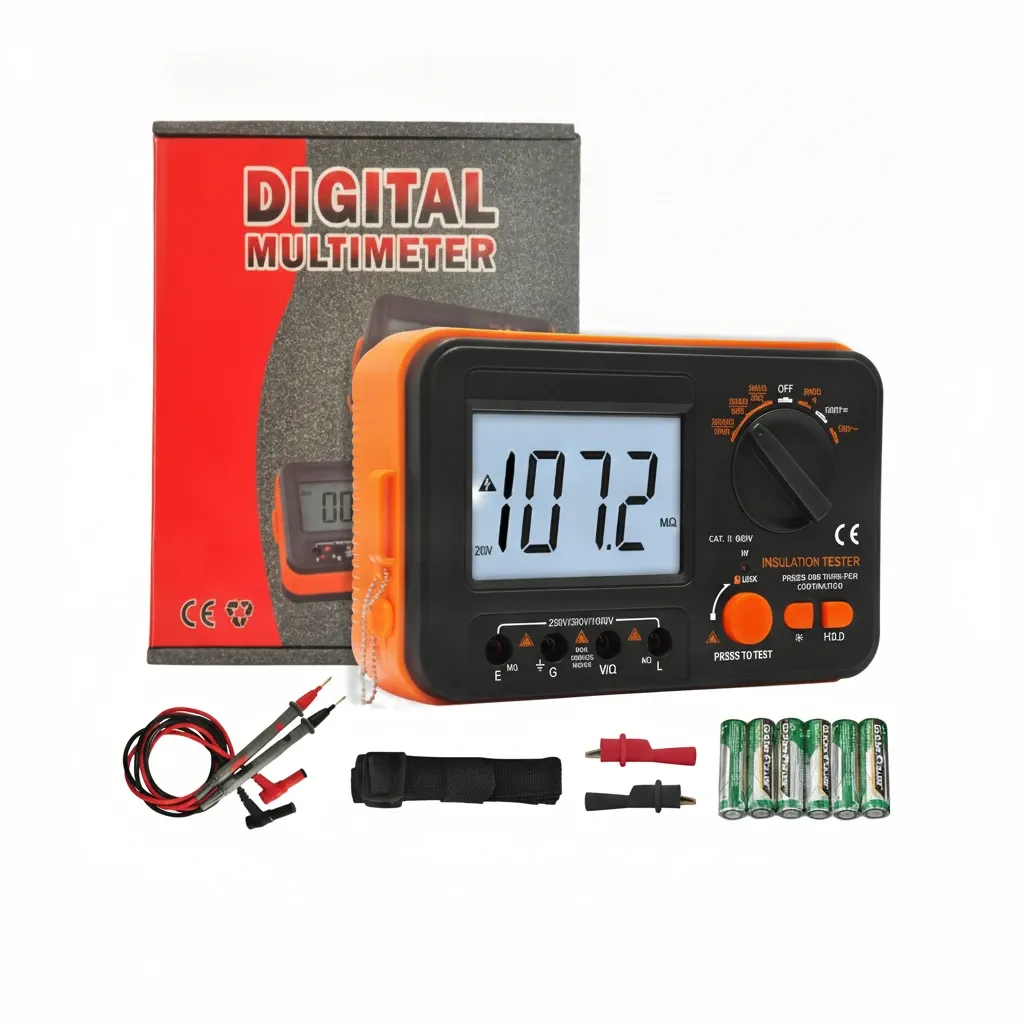
TL;DR: An electrical insulation tester applies a DC test voltage (typically 250V, 500V or 1000V) across insulation and measures the tiny leakage current, showing the result in megohms (MΩ). If you are an apprentice buying your first standalone tester, it is the tool that teaches you dead testing — it does not replace a full multifunction tester (MFT) for certification, but it is ideal for learning voltage selection and practising fault-finding on an isolated circuit.
To answer the question directly, an electrical insulation tester is an instrument designed to check the integrity of insulation around conductors. Electrical faults rarely announce themselves early. A cable can look intact, a motor can still run, and a distribution board can appear serviceable while insulation resistance is already declining in the background. Consequently, this is where a tester earns its place: it helps identify weakness before it becomes a critical issue.
In practice, choosing your first tester is less about brand and more about learning good habits: isolate the circuit, prove it dead, select the right test voltage, take the reading, then discharge safely afterwards. The Megohmmete Pro digital insulation tester is built for exactly that — selectable 250V, 500V and 1000V ranges, insulation measured up to 2000 MΩ and a backlit display for dim lofts and cupboards — at £69.31 inc VAT (£57.76 ex VAT). It runs on 6 × 1.5V AA batteries, which are not included, so pack a set before your first college session or site visit.
This guide explains what an electrical insulation tester does, how to choose between 250V, 500V and 1000V, where it fits alongside a multifunction tester, and what an apprentice should check before buying one in the UK. For the hands-on procedure itself, see how to perform an insulation resistance test.
Key Takeaways
- An electrical insulation tester measures insulation resistance by applying a DC test voltage and checking leakage current, showing the result in megohms (MΩ).
- Under BS 7671 Table 64, the test voltage follows the circuit: 250V DC for SELV/PELV (min 0.5 MΩ), 500V DC for standard 230V/400V circuits (min 1.0 MΩ) and 1000V DC above 500V (min 1.0 MΩ).
- It is a diagnostic and learning tool — it does not replace a calibrated multifunction tester (MFT) for issuing an EICR or installation certificate, and it is not a PAT tester.
- For your first meter, check the test voltages, the CAT rating and GS38-compliant leads, and whether batteries are included.
- IET Guidance Note 3 suggests investigating any new-installation result below 20 MΩ, even though 1 MΩ is the regulatory minimum.
What is an electrical insulation tester used for?
Primarily, an electrical insulation tester is a specialist instrument used to measure the resistance of insulating materials in electrical systems and equipment. In practical terms, it checks how well insulation prevents unwanted current flow between conductors or from a conductor to earth.
Unlike a standard multimeter, which generally works at low test voltages for voltage, continuity, or resistance checks, an insulation tester applies a much higher DC voltage. Consequently, this assesses insulation integrity under more meaningful, real-world conditions. The result is typically shown in megohms (MΩ), gigohms (GΩ), or sometimes teraohms on higher-end instruments.
Additionally, you may also hear people refer to this type of instrument as a megohmmeter or “megger” in general workshop conversation. If you want to compare terminology and buying considerations in more detail, see Megohm Meter Explained: A UK Buyer’s Guide.
Why is insulation testing important?
Insulation breakdown leads to electric shock risk, fire risk and nuisance RCD tripping. That is why insulation resistance testing is a required part of initial verification and periodic inspection under BS 7671 (the IET Wiring Regulations): weak insulation should be found while the circuit is dead, not when it faults in service.
As an apprentice, this is one of the first "dead tests" you will practise on a college rig or under supervision on site. The value is in the habit — isolate, prove dead, test, record and discharge — long before you are signing anything off. The tester tells you whether a cable or accessory is sound; your competence, and later a calibrated MFT, tells you whether the installation complies.
How does an electrical insulation tester work?
How do you measure insulation resistance?
The basic principle is straightforward: an electrical insulation tester applies a known DC voltage across the insulation being tested. It then measures the tiny amount of current that leaks through or across that insulation. Consequently, from that relationship between voltage and leakage current, the instrument calculates the resistance using Ohm's Law.
What is a good insulation resistance reading?
Generally, a higher resistance reading indicates better insulation condition. Conversely, a lower reading can point to contamination, moisture ingress, ageing insulation, physical damage, or deterioration caused by heat and vibration.
However, the reading itself should never be viewed in isolation. Temperature, humidity, equipment condition and previous results all matter. A good habit to build early is recording readings rather than relying on a single pass-or-fail snapshot — a new circuit that reads only 5 MΩ technically passes the 1 MΩ minimum, but IET Guidance Note 3 says a result that low is worth investigating.
What voltage should I use for insulation testing?
The test voltage follows the circuit under test, per BS 7671 Table 64 — it is not a case of "higher is better":
- 250V DC: SELV and PELV circuits (nominal voltage up to 50V); minimum acceptable insulation resistance 0.5 MΩ. Also used for the post-connection re-test where sensitive electronics remain connected.
- 500V DC: standard 230V single-phase and 400V three-phase circuits — the setting you will use most; minimum 1.0 MΩ.
- 1000V DC: circuits operating above 500V; minimum 1.0 MΩ.
Selecting 1000V "to be safe" on a 230V circuit with electronics still connected can damage them, so match the voltage to the job. If in doubt, disconnect sensitive equipment and test the wiring on its own — the full method is covered in how to perform an insulation resistance test.
Why does digital accuracy matter?
A modern digital electrical insulation tester gives clearer readings than older analogue-style interpretation alone. Furthermore, that helps when you need repeatable results across multiple assets or when documenting readings for maintenance records. For professional diagnostics on motors, cables, and industrial plant, stable digital measurement significantly reduces guesswork.
What equipment requires electrical insulation testing?
The range of applications is incredibly broad. In UK commercial and industrial work, common uses include:
- Cables: Checking deterioration due to ageing, moisture, or mechanical stress.
- Motors: Assessing winding-to-earth or winding-to-winding insulation condition during maintenance shutdowns.
- Switchgear and control panels: Identifying contamination or breakdown risk before faults escalate.
- Fixed installations: Supporting inspection and testing activity in line with site procedures.
- Pumps, fans and HVAC equipment: Spotting degrading motor insulation before a complete breakdown occurs.
- Industrial machinery: Helping isolate whether an issue lies with supply wiring or internal components.
- Maintenance stores acceptance checks: Verifying spare motors or stored cable stock before installation where suitable procedures allow.
If your interest sits specifically around very high-value resistance, choose a tester with an appropriately scaled measurement range; for interpreting readings in the gigohm region on plant, see the high resistance meter guide.
Can an electrical insulation tester replace a multifunction tester?
No — and this is the question most apprentices ask first. A standalone electrical insulation tester does one job well: it measures insulation resistance. A multifunction tester (MFT) also does continuity, loop impedance, RCD and polarity, and is what you (or a qualified electrician) use to complete an Electrical Installation Certificate or EICR. Treat a dedicated insulation tester as a learning and fault-finding tool that lives happily alongside an MFT, not a shortcut around one. It is also not a PAT tester.
Because it is not a certification instrument, confirm with your college assessor or employer that the model you buy is acceptable for your course or workplace before you rely on it. For the residential fault-finding side of the job, see the megger test explained; to compare accuracy and range in more detail, see the complete digital insulation tester guide.
What should an apprentice check before buying?
- Test voltages: 250V, 500V and 1000V covers UK college and site work. The Megohmmete Pro offers all three.
- Range: reading up to 2000 MΩ is plenty for healthy circuits that sit well above the 1 MΩ minimum.
- Safety rating and leads: look for a stated CAT rating (the Megohmmete Pro is described as a CAT III 600V equivalent design) and GS38-compliant leads — probes with finger barriers and no more than 4mm of exposed tip. Confirm the exact lead and GS38 detail with the seller.
- Batteries: this unit takes 6 × 1.5V AA batteries, which are not included — a classic first-day catch.
- Backlit display: genuinely useful in a dark loft, riser or airing cupboard.
The Megohmmete Pro is £69.31 inc VAT (£57.76 ex VAT) with free UK delivery over £50, a 12-month warranty and 30-day returns — a sensible, low-risk first tester while you build experience. One honest note: the published specification does not state a formal accuracy figure, so if a college task needs one, ask the seller to confirm it rather than assume.
Need a dependable insulation tester for site work?
Megohmmete Pro — 250V/500V/1000V, 0.1–2000 MΩ range. Free UK delivery on orders over £50.
View Megohmmete Pro — £69.31